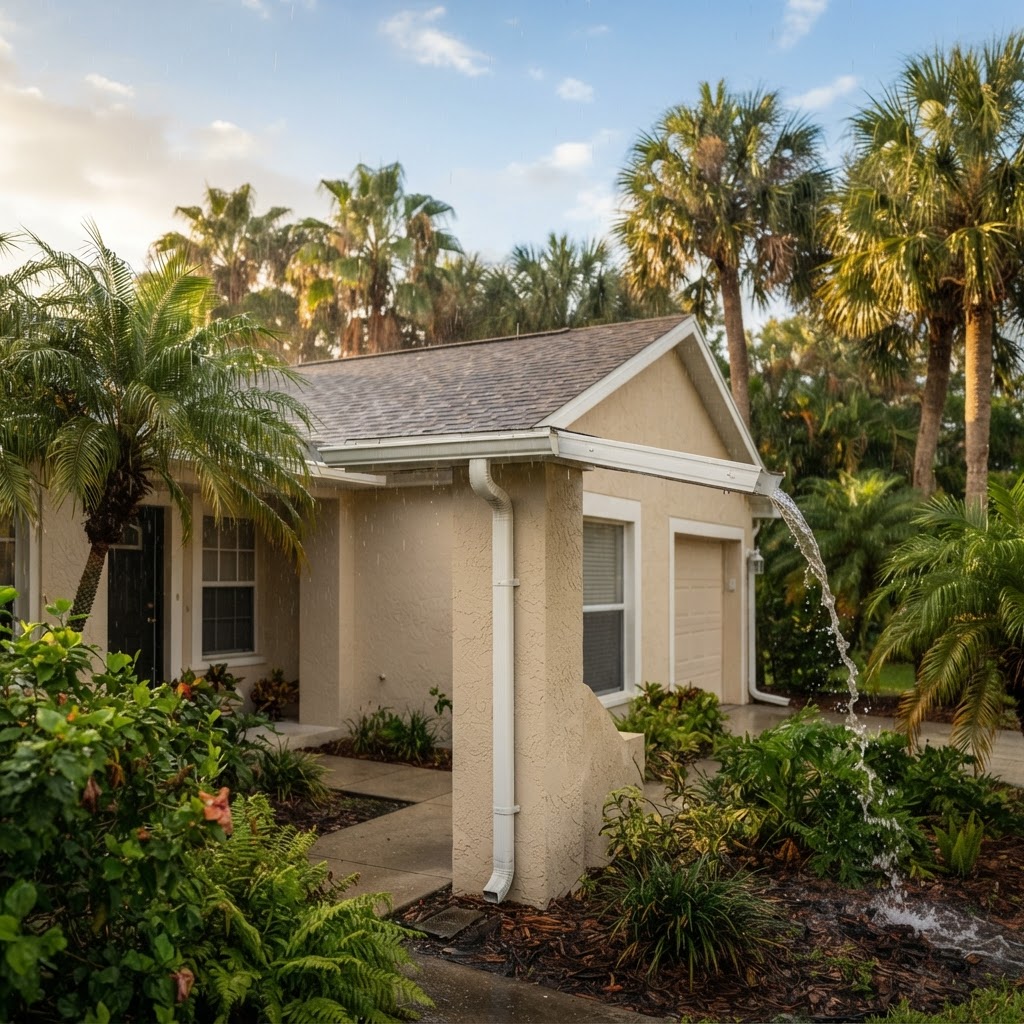
No scare stories here — just the mechanics, because they're persuasive enough on their own. Florida homes sit on slab foundations, on sandy soil, under some of the heaviest residential rainfall in the country. Without gutters, all of it lands in a drip line a foot from the slab.
The first effect is erosion you can watch: the drip line trenches itself, splashes soil onto the walls, and washes fines out of the ground closest to the foundation. Sandy soil gives up its structure to moving water readily — that's what sand does.
The second effect is slower: moisture cycling. Soil against the slab saturates in every storm and dries between them, over and over. The wet-dry cycle moves soil, settles it unevenly, and keeps the slab's edge environment damp — which is also an open invitation to the subterranean termites Florida grows so well, who travel through moist soil and find damp wood from there.
The third effect is the one nobody sees: water finding the low route. Water against a slab follows any path it can — under walkways, along utility penetrations, toward the one corner of the lot that never quite dries. Interior symptoms like a musty room corner or darkened grout at an exterior wall often trace back, step by step, to a roofline with no working water path.
None of this happens in a season, which is exactly why it gets ignored — and why the fix is cheap relative to what it prevents: gutters sized to the roof, downspouts placed sensibly, and discharge that carries the water away. That whole path is one job to us, and looking at your house is free.