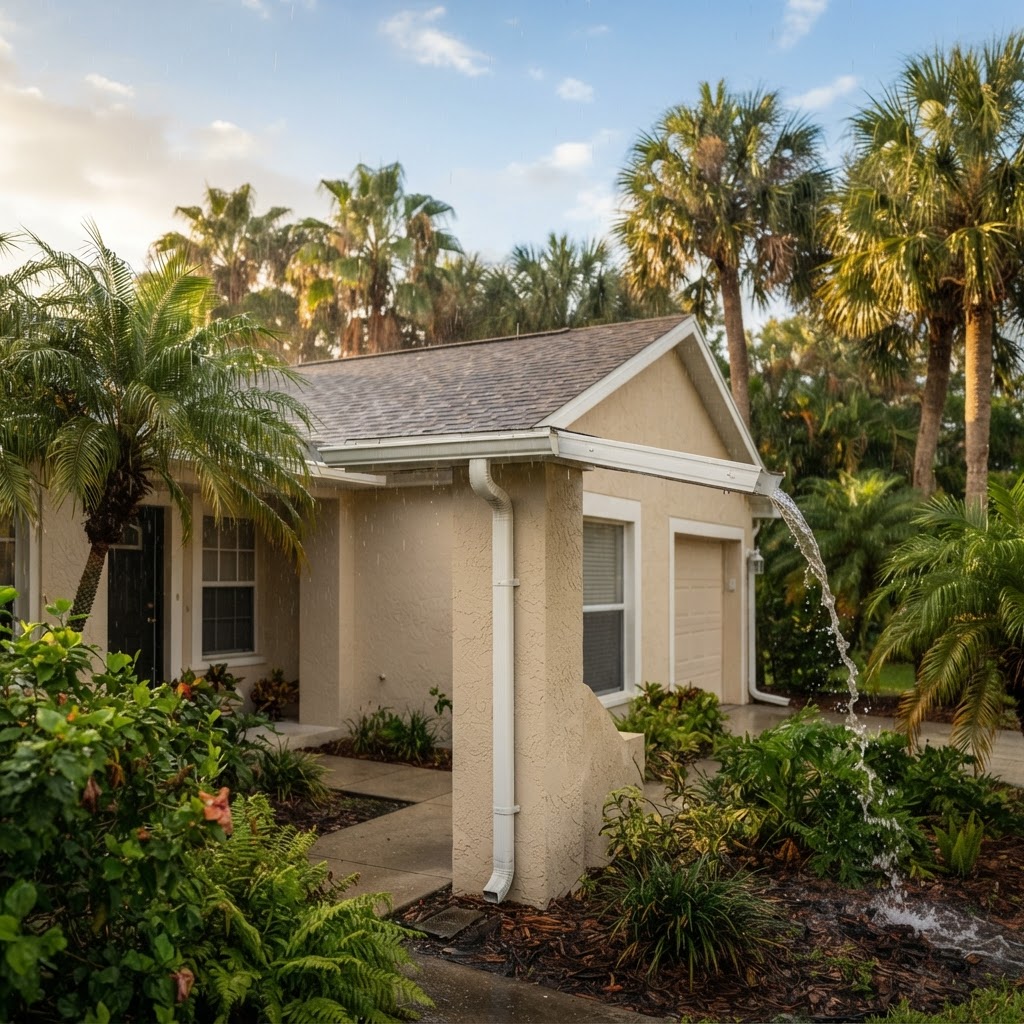
A downspout's job isn't done when the water reaches the ground — that's just where the gutter's responsibility gets handed off. Where the handoff happens decides whether the system protected your foundation or delivered the problem to it.
Rule one: away from the slab, farther than feels necessary. Water discharged near a foundation soaks the soil against it, and in Florida that soil may stay wet for days. The plain-language test: if you can stand at the foundation wall and see the discharge point at your feet, it's too close.
Rule two: onto ground that slopes away. Distance means nothing if the grade brings the water back. A downspout extension that dumps onto a slope toward the house has only added a scenic route.
Rule three: concentrated water needs a real destination. A roof section can put a startling volume through one downspout in a hard storm — more than a splash block and a prayer can spread. The upgrade path is honest and incremental: extensions beat nothing, surface routing beats extensions, and buried hard-pipe to a pop-up emitter or downspout discharge outlet beats everything, because it removes the water instead of relocating it.
Rule four — the one for hiring: any gutter quote should answer 'then where does the water go?' for every downspout on the plan. If the quote stops at the elbow, it's a quote for half a system. Ours don't stop there, and the walk-around that proves it is free.