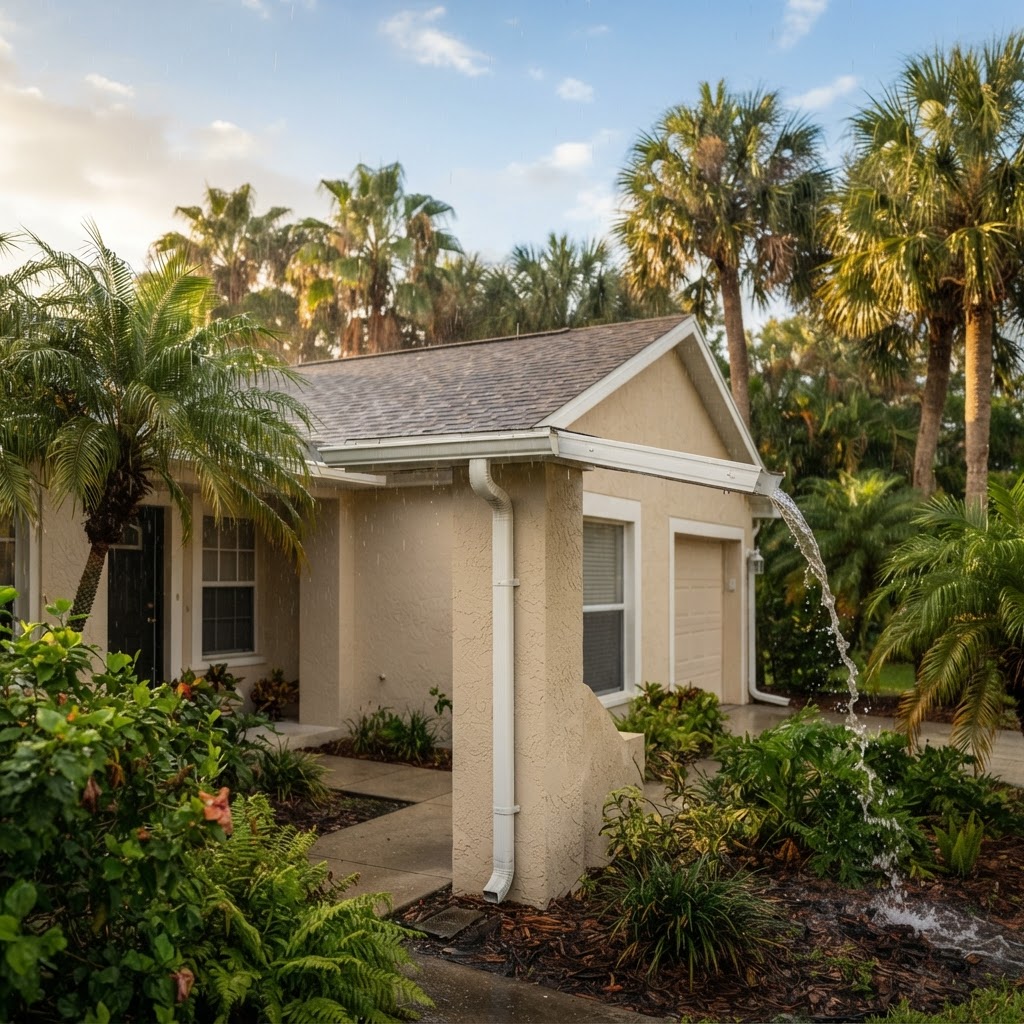
Every buried drainage run ends somewhere, and that ending determines whether the system works. A perfect trench with a bad outlet is a very tidy way to store water underground.
An open downspout discharge outlet is the best ending when the lot allows it: the pipe simply exits the ground on a downhill slope and the water walks away by gravity. It can't clog shut, it can't fail mechanically, and you can see it working. The catch is that it needs real fall — and much of Northeast Florida is flat enough that an open outlet isn't on the menu.
Pop-up emitters are the flat-lot workhorse: a fitting at the end of the run with a lid that lifts under water pressure and reseats when flow stops. Set flush in the lawn, invisible to the mower, and it releases water out where the ground can spread it. Two honest requirements: the emitter must sit lower than the inlet (water doesn't flow uphill, even in a pipe), and the lid needs an occasional check — grass clippings and mulch will eventually test it.
Street and swale routing sends water toward infrastructure built to receive it, where local rules allow. On tight lots it's sometimes the only honest option.
The failure we get called to fix most often is the run that ends nowhere — pipe that just stops underground, or an emitter set higher than its inlet. Water finds these mistakes in the first storm. When we walk a drainage estimate, the discharge point is the first thing we plan, not the last — because the outlet is the system.