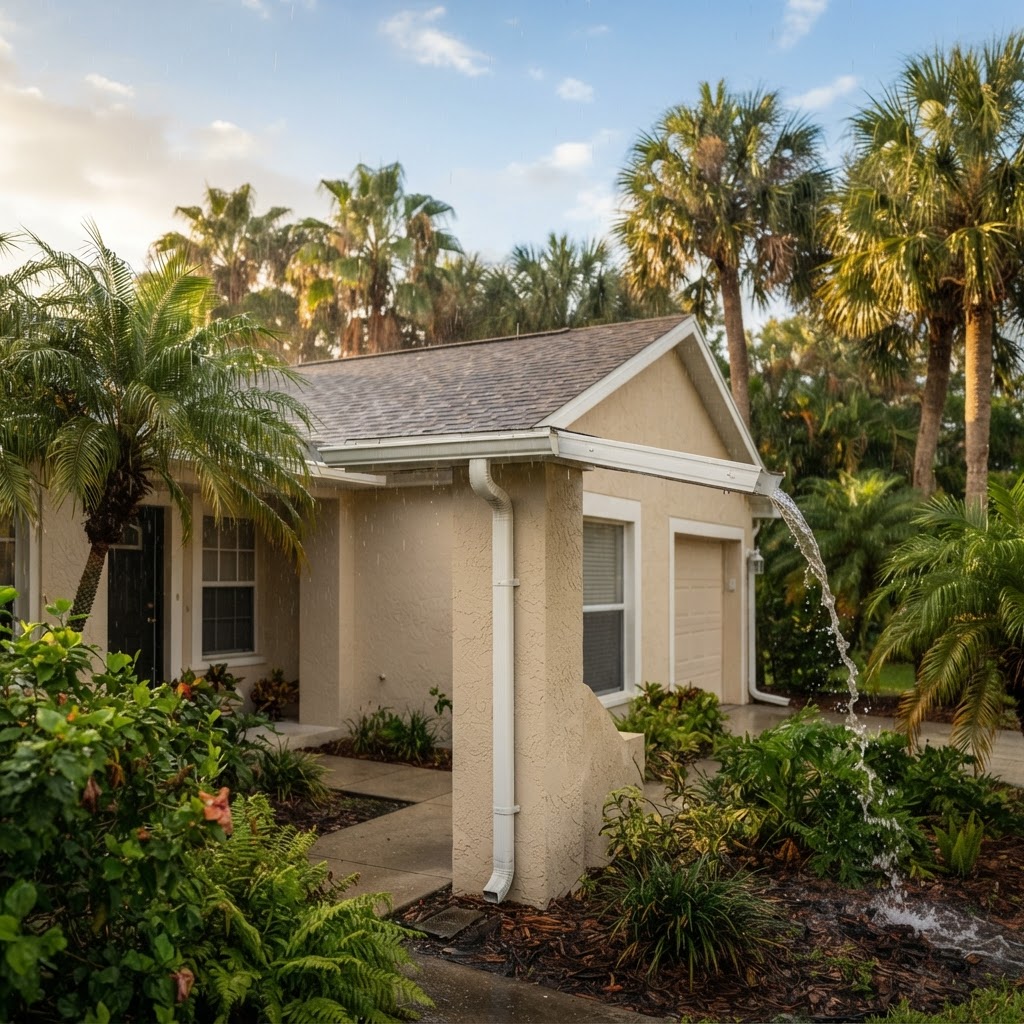
Northeast Florida's lots are flat because the land is flat — much of the region sits on old coastal terrain with barely any natural fall. Water obeys slope, and on ground with no slope, rain has no instructions. It sits.
The sandy soil helps until it doesn't. Sand drains fast, which is why a light rain vanishes here. But sand drains into the water table, and ours is high — often just a few feet down, higher still in the wet season. When summer storms stack up, the ground below is already full, the sand has nowhere to pass water along to, and the surface starts holding everything new that falls.
Add a roof and the equation tips. A house concentrates a couple thousand square feet of rainfall into a handful of downspout points, most of which dump within a few feet of the slab. On a flat, saturated lot, that water joins the standing pool instead of leaving.
The fixes work because each one gives water the instruction the flat ground doesn't: grading creates fall where there was none, so water sheds instead of sits; catch basins and channel drains collect water at the low points and hand it to buried pipe; and the pipe carries it to a discharge point that keeps working when everything is wet. Most flat-lot problems need some mix, in that order of consideration — grade first, collect second, pipe third. Which mix your lot needs is exactly what a free walk-through tells us.